









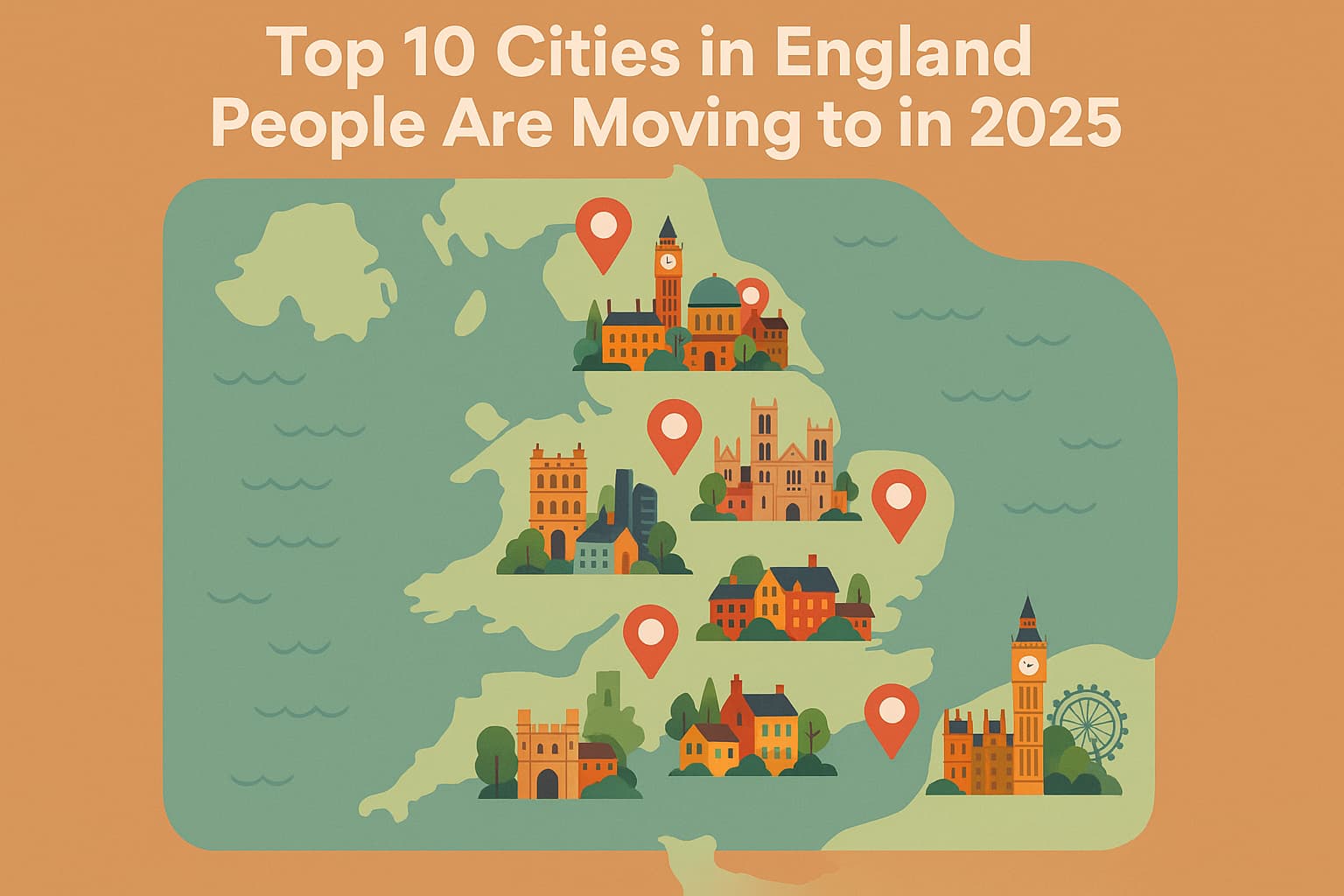
England’s “moving map” in 2025 is being redrawn by three practical forces: value for money, access to good work, and day-to-day liveability. As mortgage affordability shifts, rents cool in some markets, and employers keep favouring large regional hubs, more people are choosing cities that feel easier to live in—without giving up career options, culture, or connectivity.
This guide breaks down the top 10 English cities people are moving to in 2025—and why, using a blend of housing and rent indicators, current demand signals, and the on-the-ground factors that make a place “stick” once the excitement of moving day fades.
Introduction
Moving in 2025 is less about chasing a postcode “status” and more about engineering a better weekly routine. People are asking sharper questions: How long will the commute actually take on a bad day? Can we afford a home that still lets us save? Will the city still feel enjoyable in winter, not just on a sunny weekend? Those questions are pushing attention towards cities with strong job markets, improving transport, and neighbourhoods where you can still get space without feeling cut off.
At the same time, the national backdrop matters. House prices in England have been rising modestly overall, while rent inflation has been slowing relative to the post-pandemic peak, altering the rent-versus-buy calculation for many households. International migration has also cooled sharply compared with the year before, which feeds into rental demand and availability in some areas.
How this list was chosen (and what “moving to” means here)
There is no single perfect dataset that ranks “moves into cities” in real time. So this list uses a triangulation approach:
- Demand signals: what buyers and renters actively search for, which often leads actual moves (useful as a near-term indicator).
- Housing and rent realities: current local house price and rent levels, because affordability is the anchor constraint for most movers.
- Liveability drivers: jobs depth, universities, transport, culture, and the “everyday infrastructure” (healthcare access, schools, parks, high streets) that makes a city workable long-term.
Important note: “City” is used in the everyday sense (major urban centre). For Bath, the most robust published housing stats are by the local authority area Bath and North East Somerset, which broadly reflects the Bath market movers consider.
Snapshot table: housing and rent reality (late-2025 data as a practical proxy for 2025 moves)
Figures below are ONS local housing indicators (average house price and average monthly private rent), which are among the clearest comparable baselines across places.
| City | Avg house price | Avg monthly rent | What tends to pull movers in 2025 |
|---|---|---|---|
| Manchester | £254,000 | £1,324 | Jobs breadth + “big city” life at lower cost than London |
| Birmingham | £234,000 | £1,075 | Career scale + central connectivity + neighbourhood choice |
| Leeds | £246,000 | £1,104 | Professional services + strong city centre living |
| Bristol | £358,000 | £1,824 | Tech/creative economy + lifestyle + access to countryside/coast |
| Liverpool | £185,000 | £873 | Value + culture + growing city-centre and waterfront demand |
| Sheffield | £214,000 | £907 | Green space + affordability + walkable neighbourhoods |
| Nottingham | £194,000 | £1,001 | Value + student-to-professional pipeline + good connectivity |
| Newcastle upon Tyne | £206,000 | (local rent varies; ONS house price shown) | Value + quality of life + strong identity and cultural scene |
| York | £310,000 | £1,134 | Heritage + rail connectivity + family appeal |
| Bath (B&NES) | £418,000 | £1,770 | High-amenity historic city + London corridor access |
Top 10 Cities in England People Are Moving to in 2025—and Why
1) Manchester – the “career-density” city that still feels liveable
Why are people choosing it in 2025
Manchester remains one of the clearest alternatives to London for people who want serious job options without London-level housing pressure. It has the kind of employment mix—digital, media, professional services, higher education, health, and advanced industry—that makes career changes possible without relocating again.
There is also a psychological factor: Manchester feels like a city where you can scale up your life. More neighbourhood choice. A bigger events calendar. A strong airport. And a housing market that, for many, keeps home ownership within reach sooner than the South East.
Housing reality (what movers need to know)
The local average house price has been around £254,000, with average monthly rents around £1,324 in late-2025 indicators.
For movers, this usually translates into a wider range of “first step” options: apartments close to the centre, terraces in established inner suburbs, and family homes further out—often with workable rail/tram links.
Best fit for
- Early-career professionals who want a large job market
- Couples upgrading space without losing city life
- Families who want a suburb feel with an urban core nearby
2) Birmingham – the “connected core” choice for flexibility and access
Why people are choosing it in 2025
Birmingham’s main advantage is optionality. It sits at the centre of the rail network, has a large and varied economy, and offers many different living styles—city-centre apartments, canalside neighbourhoods, classic suburbs, and commuter towns at the edges.
If you are planning a move that must navigate uncertainty—job changes, hybrid work, childcare shifts—Birmingham can be a strategic choice because it keeps more geographic options open.
Housing reality
Average house prices sit around £234,000, with average monthly rents around £1,075 on the ONS local indicators.
That combination often attracts movers leaving higher-cost regions who still need a major-city labour market.
Best fit for
- People needing national connectivity
- Households balancing cost and career
- Movers who want many neighbourhood “types” in one city
3) Leeds – the professional-services magnet with a strong urban lifestyle
Why people are choosing it in 2025
Leeds draws movers who want a fast, modern city centre and a deep pool of professional jobs. It has the “weekday engine” that makes relocation sensible (work, career progression, commuting practicality) and the “weekend pull” that makes it enjoyable (shopping, food, sport, day trips).
Leeds also tends to perform well for people who want a city where you can live centrally without it feeling like a compromise—particularly if you enjoy walkable routines.
ONS local indicators show average house prices around £246,000 and average rents around £1,104.
In
Housing reality
practical terms, Leeds can offer a better price-to-space trade-off than comparable southern cities, while still delivering big-city amenities.
Best fit for
- Professionals in finance, legal, consulting, health, education
- People who want urban living without London costs
- Movers who want Yorkshire access without going fully rural
4) Bristol – the lifestyle-and-jobs blend (with a price tag)
Why people are choosing it in 2025
Bristol continues to pull movers because it blends economic strength (tech/creative/engineering) with a lifestyle that feels distinct: independent food culture, green neighbourhoods, and quick access to countryside and the South West coast.
For many households, Bristol represents a “best of both worlds” move: less intensity than London, but still a city where careers can grow. That is a powerful draw in a year where work-life design is driving relocation decisions.
Housing reality
Bristol is one of the pricier cities in this list: average house price around £358,000 and average monthly rent around £1,824 on ONS local indicators.
That means Bristol works best for movers with stable incomes or dual earners, or for those happy to trade size for location.
Best fit for
- Tech/creative workers and founders
- Movers prioritising lifestyle and “city character”
- People happy to pay more for amenity and access to nature
5) Liverpool – value, culture, and an increasingly serious housing story
Why people are choosing it in 2025
Liverpool’s pull is no longer only cultural (though that remains huge). It has become a value-driven relocation choice for people who want a large city experience but have been priced out elsewhere.
A key factor for 2025 is momentum: regeneration areas, a strong visitor economy, and a mature city-centre living offer. For many movers, it feels like a place where your money stretches further without stepping down to a small-town lifestyle.
Housing reality
ONS local indicators show an average house price around £185,000, with average monthly rents around £873—notably lower than many other major cities.
That gap is exactly what draws movers who want to regain financial breathing space.
Best fit for
- First-time buyers focused on affordability
- Remote workers who still want a vibrant city base
- Households prioritising culture and community energy
6) Sheffield – the green city that suits people rebuilding “everyday calm”
Why people are choosing it in 2025
Sheffield has a different appeal: it is often chosen by people who want a city that feels less pressured. It is well-known for access to green space and for neighbourhoods that can feel genuinely community-led.
In 2025, that matters because a lot of movers are not chasing status—they are chasing sustainable routines: better walks, less commuting stress, and a housing market that allows savings again.
Housing reality
ONS local indicators show average house prices around £214,000 and average monthly rents around £907.
For families and first-time buyers, Sheffield’s affordability often creates options that would be out of reach in similarly attractive southern locations.
Best fit for
- People who want city + nature in one place
- Families wanting space without extreme costs
- Anyone prioritising calm over constant bustle
7) Nottingham – the “smart value” city with strong student-to-career flow
Why people are choosing it in 2025
Nottingham benefits from a steady pipeline of young adults who study, build networks, secure early roles, and then decide to stay. That feeds into a city that has energy but can still be affordable.
It also has a practical advantage: it is well placed for connections to other parts of the country, which suits hybrid workers and couples with split workplace locations.
Housing reality
ONS local indicators put the average house price around £194,000, with average monthly rent around £1,001.
Nottingham is often chosen by movers who want a decent urban lifestyle while keeping a realistic savings plan.
Best fit for
- Graduates staying on after university
- First-time buyers who want a “proper city”
- Hybrid workers who still value central access
8) Newcastle upon Tyne – high character, strong identity, and good value
Why people are choosing it in 2025
Newcastle’s appeal is often described in human terms: it is friendly, culturally rich, and has a strong sense of identity. But the strategic reason people move is simpler: quality of life per pound can be excellent.
Newcastle also benefits from a growing narrative that you do not have to live in the South to have a meaningful career—especially as remote and hybrid work remain common in many sectors.
Housing reality
ONS local indicators show an average house price around £206,000.
Many movers find this level of pricing allows a higher standard of housing than they could afford in other large English cities.
Best fit for
- Remote workers seeking better value
- People who want a strong local culture
- Buyers who prioritise space and character
9) York – heritage, connectivity, and a strong family/commuter mix
Why people are choosing it in 2025
York attracts movers who want a city that feels safe, established, and easy to love—with the added advantage of rail connectivity for commuting and travel. It is especially popular for households thinking about schools, walkability, and a strong civic feel.
It is also in demand as a “goldilocks city”: large enough to have amenities, small enough to feel manageable.
Housing reality
ONS local indicators show average house prices around £310,000 and average monthly rent around £1,134.
That pricing reflects York’s desirability: it is not the cheapest option, but many movers accept the premium because the city delivers stability and quality.
Best fit for
- Families and mid-career movers
- People who want historic character without losing convenience
- Commuters needing good rail links
10) Bath – the high-amenity historic city for people trading money for “finish”
Why people are choosing it in 2025
Bath is chosen by movers who are willing to pay more to live somewhere that feels complete: beautiful streets, strong cultural life, and a well-defined centre. It suits people who want a refined pace, a strong visitor economy, and a city that does not require constant effort to be enjoyable.
In 2025, Bath also benefits from the broader “quality of place” trend: as people spend more time living locally, they value the daily aesthetic and walkability.
Housing reality
ONS local indicators for Bath and North East Somerset show an average house price around £418,000, and an average monthly rent around £1,770. Office for National Statistics
In other words: Bath is usually not a “stretch to make it work” move. It is a “we can afford it, and we want it” move.
Best fit for
- Higher-income households prioritising amenity and beauty
- People who prefer smaller-city calm with strong culture
- Movers focused on long-term lifestyle satisfaction
A practical “why” behind the trend: what is changing in 2025?
1) Housing decisions are more numbers-driven than ego-driven
Across England, the context is a housing market where price growth has been moderate overall, but local differences are substantial. That pushes movers to compare cities carefully rather than follow reputation alone.
2) Rent pressure is still real, but the pace has eased
ONS indicators show rent inflation slowing compared with previous periods, even if rent levels remain high in many places. This is reshaping decisions about where renting is “worth it” versus where buying becomes realistic.
3) Demand signals show major regional cities remain dominant
Rightmove’s 2025 “most searched” list highlights the ongoing pull of major cities—especially Manchester, Bristol, Liverpool, Sheffield—which aligns closely with the cities people discuss when planning relocations.
How to choose your best city (a fast decision framework)
Step 1: Decide your non-negotiables
- Maximum acceptable housing cost
- Maximum commute time (on a bad day)
- Must-have lifestyle features (green space, nightlife, schools, walkability)
Step 2: Match the city to your life stage
- Early career: job density and social networks matter most
- Family stage: space, schools, routine stability dominate
- Remote work: value, airport/rail, and daily quality of place rise in importance
Step 3: Run a “real week” test
Before committing, visit and simulate a normal day: supermarket run, school route, evening walk, transport at peak time. A city can look perfect online and still fail the weekly-routine test.
FAQs
1) What is the best city in England to move to in 2025 for jobs?
The best city depends on your sector, but Manchester, Birmingham and Leeds consistently stand out for job variety and career mobility. They offer large labour markets, multiple major employers, and strong professional networks. If you want London-like opportunity with lower housing pressure, Manchester is a common choice. For national connectivity and scale, Birmingham is hard to beat.
2) Which English city is most affordable to move to in 2025?
Affordability varies by neighbourhood, but Liverpool, Sheffield, Nottingham and Newcastle tend to offer lower average house prices than many comparable cities. Liverpool, in particular, shows a relatively low average house price on local indicators, which can improve first-time buyer chances. Always compare both rent and purchase costs, plus transport and childcare, not just house prices.
3) Where are people moving to instead of London in 2025?
Many movers look to regional cities that still provide strong careers and culture—especially Manchester, Birmingham, Leeds and Bristol. These cities often feel like the most realistic “London alternatives” because they offer sizeable job markets, major transport links, and vibrant city life. Demand signals from property searches also highlight Manchester and Bristol as consistently popular choices beyond the capital.
4) Is Bristol still worth moving to in 2025 given the higher costs?
Bristol can be worth it if you value lifestyle, green space, and a strong tech/creative economy and you can comfortably afford the higher housing baseline. Local indicators show higher average prices and rents than many cities in the North and Midlands. If moving would stretch your budget too tightly, nearby areas with good links can sometimes offer a better balance without losing Bristol’s benefits.
5) Which city is best for families moving within England in 2025?
For families, York is often attractive for its walkable centre, strong “settled” feel, and rail connectivity, while Sheffield appeals for green space and relative affordability. Birmingham also works well for families because of neighbourhood choice and connectivity. The right answer depends on whether your priority is schools and stability (often York), space and nature (often Sheffield), or flexibility and access (often Birmingham).
6) Are rents going up or down in England in 2025?
Rents have generally continued rising, but the pace has been slowing compared with earlier peaks, according to national measures. That does not mean every city gets cheaper—some places still see strong demand and limited supply—but it does suggest a less frantic market in many areas than in prior years. Checking local rent levels city by city remains essential before you decide to move.
7) How should I shortlist cities before moving in 2025?
Start with three filters: budget, commute reality, and lifestyle must-haves. Use average price and rent indicators as a baseline, then narrow to neighbourhoods that match your routine—schools, parks, stations, and high streets you will use weekly. Finally, do a “real week” visit: travel at peak time, shop locally, and walk the area after dark. That practical test prevents expensive mistakes.
Conclusion
England’s most popular moving destinations in 2025 are not random—they are the cities that best balance opportunity, affordability, and liveability. Manchester, Birmingham, Leeds and Bristol keep winning because they offer scale and jobs. Liverpool, Sheffield, Nottingham and Newcastle win because they deliver a strong quality of life without forcing financial strain. York and Bath win because they provide a high-finish, high-amenity living experience that many households actively prioritise when they can afford it.
If there is one clear lesson for movers in 2025, it is this: the “best” city is the one that supports your day-to-day system, not your occasional weekend. Use the numbers as guardrails, then choose the place where your routine feels simplest, your work options feel realistic, and your budget leaves room for a life beyond bills.