








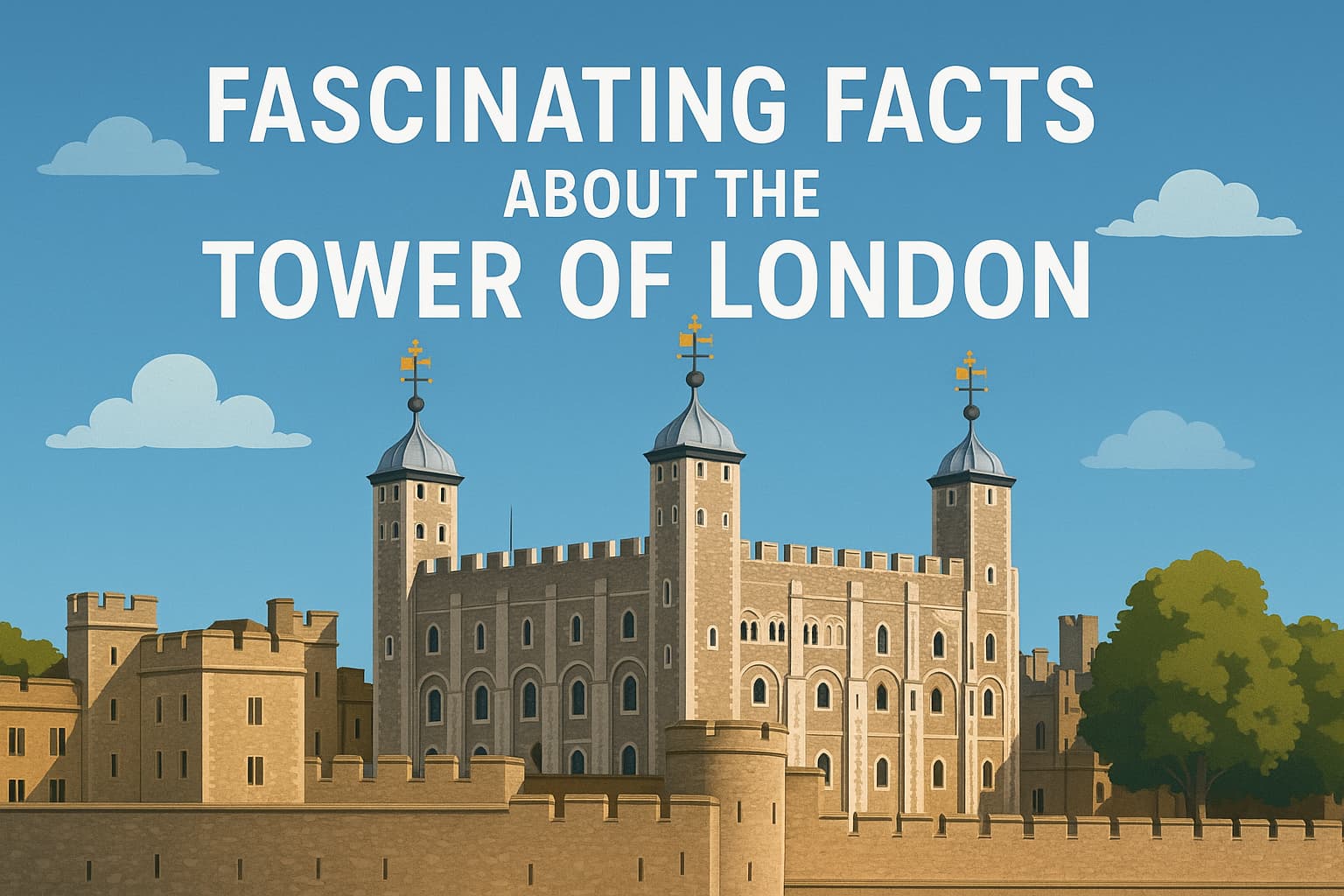
The Tower of London is a place where myth, monarchy, violence, and symbolism collide. Most visitors see its stone walls and its iconic ravens, but few truly understand the extraordinary depth of history hidden inside this ancient fortress. Beneath its battlements lie forgotten secrets, strange rituals, royal tragedies, failed rebellions, and political scandals that shaped England itself.
If you think you already know the Tower, prepare to see it differently—because its most astonishing stories are the ones rarely told.
Introduction
The Tower of London stands as one of the most recognisable landmarks in the United Kingdom, a structure so deeply woven into British history that it cannot be separated from the story of the monarchy. For nearly one thousand years, this fortress has served multiple purposes: royal palace, military stronghold, treasury, armoury, execution site, prison for the famous and infamous, and even a home for exotic animals. Every stone of the Tower holds a memory—some glorious, some terrifying, and others still shrouded in mystery.
Yet, despite millions of tourists walking through its gates each year, countless details about its past remain relatively unknown. Its role in shaping England’s political landscape, its involvement in scientific progress, its surprising connection to mythology, and the incredible lives (and deaths) of those trapped within its walls make it far more than a medieval attraction. This article brings together 10 fascinating, deeply researched facts that illuminate the Tower’s lesser-known stories. Each fact is expanded with context, background, and insider knowledge so that you get the full picture at one place—perfect for history lovers, students, travellers, and anyone curious about Britain’s most legendary fortress.
1. The Tower Was Not Built as a Prison — It Was Built to Intimidate
1.1 William the Conqueror’s Strategy of Control
When William the Conqueror ordered the construction of the White Tower in the 1070s, England had just been conquered. The Norman king needed a powerful structure to establish dominance over the rebellious Saxon population. The White Tower was intentionally designed to look intimidating—its massive stone walls, high vantage point, and military structure sent a clear message: Norman authority is here to stay.
For medieval Londoners, who had never seen such monumental architecture, the Tower symbolised absolute control. It wasn’t just a residence or fortress; it was a psychological weapon meant to suppress uprisings.
1.2 How It Became England’s Most Feared Prison
The Tower’s transformation into a prison happened slowly over the centuries. By the 13th century, kings began using it to hold political prisoners because it was secure, isolated, heavily guarded, and symbolically powerful.
Unlike common criminals, Tower prisoners were often nobles, traitors, clergy, ambassadors, generals, and even monarchs.
Some of its most famous inmates include:
- Anne Boleyn
- Guy Fawkes
- Sir Walter Raleigh
- Lady Jane Grey
- Rudolf Hess (as late as the 20th century)
Its prison reputation grew because the people it held were high-profile individuals whose fates shaped the course of English history.
2. The Ravens Are Protected by Royal Law — and Their Lives Are Luxurious
2.1 The Prophecy That Protects the Kingdom
According to folklore, “If the ravens leave the Tower, the kingdom will fall.”
This myth dates back to the time of Charles II, who insisted that at least six ravens must always remain on the grounds. The superstition became so important that a Royal Decree was issued ensuring their permanent protection.
Even today, the ravens are registered with identification numbers, monitored daily, and fed a special diet of raw meat, biscuits soaked in blood, fruit, and vitamins.
2.2 The Ravenmaster’s Daily Rituals and Responsibilities
The Ravenmaster—a specialised Yeoman Warder—wakes before sunrise to care for the birds. His responsibilities include:
- Cleaning their enclosures
- Preventing them from flying too far
- Feeding them a balanced diet
- Monitoring their health
- Training them for public interaction
Each raven has its own temperament. Some love attention; others are mischievous and known to wander around the Tower grounds, occasionally stealing food from visitors.
Their wings are traditionally trimmed (not clipped) to limit flight, but they remain powerful, intelligent creatures capable of memorising faces and solving problems.
3. The Tower Once Hosted a Royal Menagerie Filled with Exotic, Dangerous Animals
3.1 A Gift-Giving Tradition That Became a Zoo
Between the 1200s and 1800s, monarchs kept exotic animals at the Tower as diplomatic displays of wealth and alliances. Foreign rulers gifted animals such as:
- Lions
- Leopards
- A polar bear from Norway
- An elephant from France
- Ostriches
- Monkeys
- Hyenas
This bizarre collection became known as the Royal Menagerie. The polar bear famously swam in the Thames while chained to a long rope, catching its own fish.
3.2 Public Access Came with a Strange Entry Fee
During the 18th century, the menagerie became a public attraction. But visitors who couldn’t afford the entry fee could gain access by bringing a cat or dog—not as pets, but as food for the animals.
This dark and unusual practice continued until the early 19th century, when the menagerie was finally moved to Regent’s Park, forming the early foundation of what is now London Zoo.
4. Torture at the Tower: Rare, Regulated, but Terrifying
4.1 Torture Was Not a Common Practice in England
Contrary to popular belief, torture was not routinely used in medieval and early modern England. In fact, English law strictly limited the use of torture, and it required special permission from the monarch or the Privy Council.
However, when torture was used, it was almost always for cases involving high treason, espionage, or political conspiracy—crimes that threatened the stability of the Crown.
The Tower of London became synonymous with torture not because it happened often, but because the victims were high-profile individuals whose stories spread widely. These incidents etched themselves into the public memory.
4.2 The Tower’s Most Feared Instruments of Pain
The Rack
The most notorious device in the Tower’s history, the rack stretched the victim’s body by pulling their limbs in opposite directions.
It was housed in the Lower Wakefield Tower, a dim, isolated chamber designed to intensify fear.
Victims often suffered:
- Dislocated joints
- Torn muscles
- Permanent disability
- Psychological trauma
One of the most famous victims was Guy Fawkes, interrogated after the Gunpowder Plot of 1605. The signature he provided after torture shows a trembling, barely legible scrawl—evidence of intense suffering.
The Scavenger’s Daughter
Less known but equally brutal, this device compressed rather than stretched the body.
It forced victims into a crouched, folded position, causing:
- Extreme pressure on the chest
- Difficulty breathing
- Severe bruising
- Blood flow restriction
It was a favourite tool during the Tudor period, particularly under Henry VIII.
The Manacles
A simpler yet agonising method: the prisoner was suspended by the wrists with iron cuffs. Over hours, this led to:
- Shoulder dislocations
- Nerve damage
- Loss of circulation
- Fainting spells
Jesuit priest John Gerard survived this torture and later escaped the Tower, leaving behind one of the most dramatic prisoner accounts of the era.
4.3 Why the Tower Became the Centre of Interrogation
Several factors made the Tower ideal for interrogations:
- It was secure and isolated.
- It was under the direct authority of the monarch.
- High-ranking officials could oversee interrogations discreetly.
- Its reputation intimidated prisoners, which often led to quicker confessions.
In many cases, the fear of torture was more effective than torture itself. Prisoners often confessed after merely being shown the devices.
5. The Tower as the Royal Mint: The Birthplace of English Currency
5.1 The Mint Operated Inside the Tower for Over 500 Years
From the late 13th century until 1810, the Tower served as the headquarters of the Royal Mint—one of the most important government institutions in English history.
Coins struck at the Tower travelled across the entire British Empire, influencing trade, taxation, and economic policy for centuries.
Producing currency inside a fortress made perfect sense:
- Security was guaranteed.
- Skilled workers could operate safely under royal supervision.
- Raw materials like gold and silver could be stored securely.
5.2 Coin-Making Was a Dangerous, Complicated Process
Medieval coin-making was far from simple. Workers had to:
- Melt precious metals at high temperatures
- Create precise alloys
- Cut sheets into blanks
- Hammer or stamp each coin individually
Any deviation from standards was considered treasonous, because it affected the economy and the king’s authority.
Counterfeiting, underweight coins, or altering inscriptions were punishable by brutal execution methods, including boiling or hanging.
The Mint’s presence made the Tower not only a financial hub but also a symbol of economic monarchy.
5.3 Sir Isaac Newton’s Influence on the Tower Mint
One of the Tower’s most surprising historical figures is Sir Isaac Newton, who served as:
- Warden of the Mint (1696–1699)
- Master of the Mint (1699–1727)
During Newton’s tenure, he transformed the Mint through:
- Anti-counterfeiting crackdowns
- Scientific weighing and measuring techniques
- Introduction of milling edges on coins
- Standardisation of currency metals
Newton is said to have personally conducted investigations, disguising himself to catch counterfeiters in taverns and marketplaces. His reforms stabilised England’s currency during a chaotic economic period, proving he was as brilliant an administrator as he was a scientist.
6. The Princes in the Tower: England’s Most Enduring Mystery
6.1 The Disappearance That Changed British History
In 1483, after the death of King Edward IV, his 12-year-old son Edward V and his younger brother Richard were placed in the Tower by their uncle, Richard, Duke of Gloucester, supposedly for protection before Edward’s coronation.
But the coronation never happened.
Richard declared the boys illegitimate, took the throne as Richard III, and the two princes simply vanished.
Their disappearance created one of the most controversial and emotional mysteries in royal history.
6.2 Theories About What Happened to the Princes
Theory 1: Richard III Ordered Their Murder
This is the traditional explanation supported by many historians.
Motives:
- Secure his claim to the throne
- Prevent uprisings in favour of Edward V
However, there is no direct evidence linking Richard III to murder.
Theory 2: Henry VII Was Responsible
Some argue that Henry Tudor, who defeated Richard III and became Henry VII, had even more to gain by eliminating rival heirs.
If the princes were alive when Henry took power, they would challenge his legitimacy. Thus, some speculate he ordered their execution and destroyed the evidence.
Theory 3: The Princes Survived
Alternative theories suggest:
- They escaped in secret
- They were smuggled abroad
- One of them became the mysterious pretender Perkin Warbeck
Though unlikely, such theories add intrigue to the story.
6.3 Discovery of Bones in 1674
Workmen renovating the White Tower discovered two small skeletons buried beneath a staircase.
Charles II ordered the bones to be placed in Westminster Abbey, claiming they belonged to the princes.
However:
- No DNA analysis has been permitted
- The bones were found in a disturbed area
- Dating techniques have never confirmed the age
Thus, the mystery endures, leaving historians, archaeologists, and enthusiasts still debating the truth more than 500 years later.
6.4 Why This Mystery Still Captivates the World
The story of the princes resonates because it combines:
- Innocence
- Power politics
- Betrayal
- Medieval succession crises
- A lack of definitive proof
It raises fundamental questions:
- How far will people go to secure a crown?
- Who writes history—the victors or the victims?
This unsolved case continues to inspire academic research, novels, films, and public speculation.
7. The Crown Jewels: Power, Ceremony, and an Extraordinary History
7.1 A Collection Worth Billions — and Symbolically Priceless
The Crown Jewels housed in the Tower of London represent one of the most important and valuable royal collections in the world. Beyond their staggering financial worth, they carry immense political, cultural, and ceremonial significance.
The collection includes more than 100 sacred objects used in coronations, state openings of Parliament, and royal ceremonies. These items embody continuity, tradition, authority, and the divine right of kings and queens.
Among the most iconic pieces are:
- The Imperial State Crown — worn by the monarch at the State Opening of Parliament.
- St. Edward’s Crown — used to crown new monarchs since 1661.
- The Sovereign’s Sceptre — featuring the world-famous Cullinan I diamond.
- The Sovereign’s Orb — symbolising Christian monarchy.
These objects are not simply museum pieces; they remain living instruments of monarchy, still actively used in ceremonies today.
7.2 Colonel Blood’s Attempted Theft — The Most Daring Heist of the 17th Century
One of the most astonishing stories in Tower history involves Colonel Thomas Blood, an Irish adventurer who attempted to steal the Crown Jewels in 1671.
His plan was bold, reckless, and surprisingly effective—for a moment.
Blood entered the Jewel House disguised as a parson and returned several times to befriend the custodian. On the day of the heist, he:
- Knocked the keeper unconscious
- Flattened the Imperial Crown with a mallet
- Stuffed the orb into his trousers
- Tried to saw the sceptre in half
He was caught at the gate, but here is the twist: King Charles II pardoned him.
Why? Historians speculate Charles admired Blood’s audacity—or believed he was part of a larger political conspiracy worth uncovering.
This bizarre episode only deepened the Tower’s legendary status.
7.3 The Jewel House Today: High-Tech Security Meets Historic Ritual
The Crown Jewels are guarded by:
- Bomb-proof vaults
- 24/7 surveillance
- Yeoman Warders
- Armed military personnel
Visitors can observe the jewels along a moving walkway to prevent crowding or lingering near the display cases.
Despite advanced security, the true protection lies in their symbolism: stealing the Crown Jewels is not merely theft—it is an assault on British monarchy and national identity itself.
8. Ghosts of the Tower: Hauntings, Legends, and Centuries of Fear
8.1 Anne Boleyn — The Tower’s Most Famous Ghost
Anne Boleyn, executed by sword in 1536 on charges of treason and adultery, is perhaps the Tower’s most frequently sighted spirit.
Witnesses across centuries claim to have seen:
- A headless figure walking through the Tower Green
- A woman dressed in Tudor clothing near the Chapel Royal of St. Peter ad Vincula
- A floating apparition in the corridors of the White Tower
Her tragic story, combined with the injustice many believe she suffered, has kept her spirit alive in British folklore.
8.2 The Princes in the Tower — Child Spirits and Unsettled History
Some Yeoman Warders have reported hearing the faint sounds of children laughing, crying, or playing near the Bloody Tower—the place traditionally associated with Edward V and his younger brother Richard.
Though subtle, these accounts contribute to the emotional weight of the princes’ disappearance.
Whether ghostly or psychological, these experiences reflect how deeply the Tower’s history affects those who live and work there.
8.3 The White Lady, the Headless Bear, and Other Strange Sightings
Across centuries, visitors and residents have reported sightings of:
- The White Lady, appearing near the White Tower, often accompanied by a strange floral scent.
- A spectral bear, seen by a guard in the 19th century, causing him to die of shock shortly afterwards.
- Arbella Stuart, a royal cousin imprisoned for an unauthorised marriage, said to weep near her former cell.
These stories reveal how the Tower, steeped in trauma and political turmoil, has naturally become a focal point for ghost lore.
9. Executions Rarely Happened Inside the Tower — Only the Most Important
9.1 Tower Hill: The Real Stage for Public Beheadings
Many people believe that the Tower was a mass execution site, but in reality, public executions mostly took place outside the Tower, on Tower Hill.
These were large spectacles attended by thousands of Londoners.
Between 1388 and 1747, around 120 executions occurred on Tower Hill—far fewer than imagined, but still significant.
The condemned often included high-ranking nobles charged with treason or rebellion.
9.2 Private Executions Inside the Tower Grounds Were Reserved for Royalty
Only ten people in history were executed within the Tower’s inner walls. These included:
- Anne Boleyn (1536)
- Catherine Howard (1542)
- Lady Jane Grey (1554)
- William Hastings
- Robert Devereux, Earl of Essex
Why were these executions private?
Because public executions were risky—nobles often had supporters who could riot or disrupt proceedings. Quiet executions prevented rebellion and maintained political stability.
They also preserved a degree of dignity for those who still held royal or noble status.
9.3 Death by Axe: A Grim Ritual
Beheading was considered an honourable form of execution, but it was far from humane.
In some cases, the executioner missed the neck multiple times, turning the ritual into a bloody, drawn-out horror.
Lady Margaret Pole, Countess of Salisbury, famously fled around the scaffold as the executioner chased her, hacking repeatedly until she died.
These stories are part of what gives the Tower its “dark history” reputation.
10. Yeoman Warders: The Tower’s Living Guardians and Historians
10.1 Requirements for Becoming a Warder Are Extremely Strict
To qualify as a Yeoman Warder (also known as a Beefeater), a candidate must:
- Have at least 22 years of service in the British Armed Forces
- Hold the Long Service and Good Conduct Medal
- Have a spotless military record
This makes the Warders some of the most elite ceremonial guards in the country.
10.2 Warders Live Inside the Tower — A Community Within a Fortress
The Yeoman Warders and their families live in residential areas inside the Tower walls, forming a close-knit community.
Their homes, though historic, are equipped with modern amenities.
Residents share communal spaces, attend special Tower ceremonies, and participate in centuries-old traditions—making the Tower not only a workplace but a living village.
10.3 The Ceremony of the Keys: A Tradition Unbroken for 700+ Years
Every night at 10 pm, the Warders perform the Ceremony of the Keys, the oldest continuous military ceremony in the world.
This ritual involves:
- Locking the main gates of the Tower
- A precise, scripted dialogue between guards
- A salute to the King’s Guard
- A final blessing to ensure the Tower remains protected
Even during wartime, bomb raids, pandemics, and political upheaval, the ceremony has never been skipped.
It is a powerful reminder that the Tower is still an active military and ceremonial institution—not just a museum.
Historical Comparison Table: The Tower’s Evolution Over 950+ Years
| Era | Primary Purpose | Key Events | Notable Figures | Public Perception |
|---|---|---|---|---|
| 11th–12th Century | Norman fortress, royal residence | Construction of the White Tower | William the Conqueror | Symbol of conquest and control |
| 13th–15th Century | Military base, armoury, early prison | Barons’ Wars, royal captivity | Henry III, Edward I | Political power centre |
| 16th Century | High-profile prison, execution site | Tudor executions | Anne Boleyn, Thomas More | Fear, intrigue, royal scandal |
| 17th–18th Century | Royal Mint, menagerie | Attempted theft of Crown Jewels | Colonel Blood, Isaac Newton | Economic hub, curiosity |
| 19th–20th Century | Military depot, prison for spies | WWI and WWII executions | Rudolf Hess | National defence site |
| Today | World Heritage Site, museum | Modern ceremonies, tourism | Yeoman Warders | Historic treasure, royal icon |
Frequently Asked Questions (FAQs)
1. Why is the Tower of London considered one of the most important historic sites in the UK?
The Tower of London is considered vital because it has played multiple roles across nearly 1,000 years of British history. It served as a royal palace, prison, treasury, armoury, menagerie, military base, and home of the Crown Jewels. Every major political era—from the Normans to modern monarchs—left its mark on the Tower. Its surviving buildings, traditions, and stories provide a rare, uninterrupted record of England’s monarchy, justice system, warfare, and cultural evolution.
2. Are the Crown Jewels on display at the Tower the real ones used by the monarchy?
Yes, the Crown Jewels displayed in the Jewel House are authentic regalia used in official ceremonies, including coronations and the State Opening of Parliament. These objects hold immense historical and symbolic value. Security around them is extremely tight, involving modern surveillance systems and military oversight. While some historic pieces were destroyed after the English Civil War, the current collection dates mainly from 1661 onwards and represents the living ceremonial tradition of the British monarchy.
3. What makes the Tower of London’s ghosts so famous and frequently discussed?
The Tower’s ghosts fascinate people because the site has witnessed centuries of trauma, political intrigue, executions, and dramatic royal tragedies. Reports of apparitions—especially Anne Boleyn, the Princes in the Tower, Arbella Stuart, and mysterious figures in the White Tower—have circulated since the medieval period. Yeoman Warders and visitors have long documented unexplained sounds, sightings, and sensations. Whether supernatural or psychological, these stories reflect the emotional and historical weight of events linked to the Tower’s past.
4. How accurate are the stories of torture at the Tower?
While torture did occur at the Tower, it was far less common than legend suggests. English law required special permission to interrogate prisoners using torture, and it was mainly reserved for high treason. Devices like the rack, Scavenger’s Daughter, and manacles were used only in specific political cases. Nonetheless, the Tower’s association with high-profile victims—such as Guy Fawkes—created a dramatic reputation that survived long after torture itself became illegal, making the stories seem more widespread than they were.
5. Were the Princes in the Tower really murdered there, and do historians know who did it?
No definitive evidence exists to confirm the fate of Edward V and his brother Richard. Many historians believe they were murdered because they posed a threat to whoever held the crown. Richard III, Henry VII, or even factions within their courts remain possible suspects. The discovery of bones in 1674 deepened speculation but provided no conclusive proof. The case remains unsolved, making it one of Britain’s most enduring historical mysteries, continually re-examined through new theories and analyses.
6. How did the Tower of London function as a Royal Mint, and why was it so important?
For over 500 years, the Tower Mint produced most of England’s currency. It was strategically located within the fortress to protect gold, silver, and valuable dies. Skilled workers struck coins by hand, and strict quality standards ensured economic stability. Under Sir Isaac Newton’s leadership, the Mint introduced reforms to combat counterfeiting and improve accuracy. The Tower Mint shaped England’s financial systems and provided secure monetary production during periods of political turbulence and economic expansion.
7. Can you still see evidence of medieval life and architecture inside the Tower today?
Yes, much of the Tower’s medieval fabric remains intact. The White Tower, built by William the Conqueror, showcases Norman military architecture with its thick walls, narrow windows, and grand halls. Medieval graffiti carved by prisoners survives on cell walls. The Beauchamp Tower, Traitors’ Gate, battlements, chapels, and restored living quarters allow visitors to experience life from the 11th–16th centuries. Ceremonies like the Ceremony of the Keys also preserve medieval traditions in modern times.
Conclusion
The Tower of London stands as one of the most extraordinary symbols of British history because it captures every aspect of the nation’s evolution—monarchy, warfare, justice, ceremony, science, betrayal, and myth. Its walls have witnessed coronations, conspiracies, scientific reforms, royal dramas, and centuries of political power struggles. Every corner reveals another layer of England’s story, from the mysterious disappearance of the princes to the rise of the Royal Mint, the importance of the Crown Jewels, and the rituals carried out by the Yeoman Warders.
What makes the Tower remarkable is not only its survival but its ability to remain relevant. It is a living site—still guarded, still ceremonial, still filled with stories that shape how we understand Britain’s past and present. Whether you admire its architecture, its legends, or its historical significance, the Tower of London remains a place where the nation’s identity, struggles, and triumphs are preserved for future generations to explore and learn from.