








Creating a convincing 1980s British Family Portrait needs more than big hair, a patterned carpet and an old television. Those details may signal the decade, but placing every familiar retro object in one picture usually produces a costume set rather than a believable family photograph.
Real British homes changed gradually. A photograph taken in 1986 might include a sofa bought in the 1970s, a new video recorder, an older gas fire and clothes ranging from fashionable to thoroughly practical. Family pictures were often taken quickly with consumer film cameras, direct flash and little control over the final result. Some were carefully posed; many were not.
That mixture of old and new, formal and ordinary, is what gives an authentic photograph its character.
This guide explains how to turn a present-day family picture into a realistic British 1980s portrait using ChatGPT or another AI image tool. It covers the source photograph, setting, clothing, hairstyles, household objects, lighting and film treatment, followed by ready-to-use prompts and a practical authenticity checklist.
What Makes a British 1980s Family Portrait Look Real?
The strongest 1980s AI Photo Trend portraits feel as though they record a specific family, place and occasion. They do not merely display a collection of retro symbols. An AI Family Portrait Generator can achieve this effect more effectively when the prompt gives the system enough information about the family, setting and occasion.
Before writing a prompt, decide five things:
- The year: Is the photograph from 1981, 1985 or 1989?
- The location: Is it a London flat, a Birmingham suburb, a Glasgow tenement, a Welsh terrace or a Yorkshire market town?
- The occasion: Is it Christmas, a birthday, a wedding anniversary, a studio sitting or an ordinary Sunday?
- The family: What are their ages, personalities and relationships?
- The photographer: Was the picture taken by a relative using a compact camera or by a professional in a studio?
These decisions give the AI a coherent scene to build. Without them, it is likely to combine styles from different years and social settings.
Start With the Right Family Photograph
The quality of the uploaded image influences how well the AI preserves each person.
Use a photograph in which:
- Every face is clearly visible.
- The image is reasonably sharp and well lit.
- Nobody’s face is heavily covered by hair, hands or another person.
- Family members are not standing too far from the camera.
- The intended group is fully inside the frame.
- You have permission to use everybody’s likeness.
A modern family photograph does not need to resemble the final pose. AI can change the setting and clothing, but it needs a reliable view of each face. If the source contains six or seven people, expect more identity errors than with a group of three or four. A clear reference photograph gives the AI a stronger foundation for creating a Realistic Vintage Family Photo while keeping each family member recognisable
For a large family, it may be better to create smaller groups first and then produce a final arrangement. However, merging separately generated faces can introduce inconsistent lighting and proportions, so inspect the result carefully.
Tell the AI What It Must Preserve
“Make us look like a British family in the 1980s” leaves too much open to interpretation. The system may change ages, smooth faces, lighten or darken skin, alter body shapes or make relatives look unrelated.
The preservation instruction should appear near the beginning of the prompt:
Preserve every person’s recognisable facial identity, age, natural skin tone, facial structure, eye shape, body proportions and family resemblance. Do not beautify, de-age or replace any face.
You can adjust this line when a deliberate age transformation is part of the idea, but avoid contradictory instructions. Asking the tool to preserve a person’s exact age while portraying them forty years earlier may confuse it. Decide whether you want the family as they are today in a retro setting or an imagined younger version of them.
The safer and more accurate option is usually to preserve their present ages and change only the period styling.
Choose an Exact Year, Not Just “The 1980s”
The decade was not one fixed visual style. Early-1980s clothes and interiors often retained strong 1970s influences. By the end of the decade, sportswear, home electronics, hairstyles and photographic colour could look quite different.
Choosing the year is also important when trying to reproduce an authentic British 1980s Photo Style, because fashion, interiors and technology changed throughout the decade. An exact year helps the model avoid mixing too many references:
- 1981–1983: Strong 1970s carry-over, knitwear, practical coats, simpler electronics and restrained family interiors.
- 1984–1986: Familiar mid-decade styling, growing home-video culture, patterned clothing, fuller hair and a mixture of older furnishings with newer technology.
- 1987–1989: More visible sportswear, brighter casual clothes, larger spectacles, late-decade hairstyles and a greater chance of home computers or newer televisions appearing.
These are broad tendencies, not rules followed by every household. Age, income, region and personal taste mattered just as much as the date.
Select a Believable British Setting
The setting should support the family story rather than compete with it. For an AI-Generated Retro Portrait, the location should reinforce the period and family story rather than becoming a collection of obvious vintage props.
The family sitting room
This is the most recognisable choice. Depending on the household, it might contain a floral three-piece suite, patterned carpet, heavy curtains, a gas or electric fire, a wooden television cabinet, framed school photographs and a few ornaments.
Do not request every object at once. Three or four specific details are enough.
A professional photography studio
A studio portrait suits a formal family arrangement. Ask for a plain or softly painted backdrop, simple stools or chairs, balanced studio flash and restrained poses. Avoid elaborate themed scenery unless you are intentionally creating a novelty portrait.
A dining room at Christmas
Use a modest artificial tree, paper decorations, tinsel, wrapped presents and an ordinary family table. Christmas scenes become unbelievable when AI fills every surface with decorations or creates an enormous luxury home.
A back garden
This works well for birthdays, summer gatherings and informal portraits. A lawn, brick wall, simple garden furniture and neighbouring fences often feel more authentic than an immaculate landscaped garden.
A seaside holiday
A British seaside portrait can include a windbreak, deckchairs, buckets and spades or a pier in the distance. Cloudy weather, jumpers and practical clothing may be more convincing than uninterrupted sunshine.
A local high-street studio
Many families visited photography studios for formal portraits. A realistic result should look professionally lit but not like a modern fashion campaign. Specify modest styling, a simple backdrop and the print quality of the chosen year.
Look Beyond London
AI often treats Britain as a collection of London landmarks. Big Ben, red buses and telephone boxes may work for a travel photograph, but they rarely belong in a family sitting-room portrait.
Regional detail makes the image more personal. You might specify:
- A red-brick suburban home in Birmingham
- A terraced house in Manchester or Leeds
- A sandstone tenement flat in Glasgow
- A Welsh Valleys sitting room
- A Belfast family studio
- A Newcastle back garden
- A seaside guest house in Blackpool or Scarborough
- A rural cottage in Devon or North Yorkshire
Use the location only where it affects architecture, surroundings, weather or household character. Avoid turning regional identity into a stereotype.
Dress the Family for the Occasion
AI-generated 1980s fashion is often too theatrical. It dresses parents like chart stars and gives every child fluorescent sportswear.
Most family portraits need ordinary, coordinated clothing rather than fancy dress.
Clothing for adults
Depending on the year and occasion, suitable choices might include:
- A patterned blouse with a calf-length skirt
- A knitted jumper or cardigan
- High-waisted trousers
- A modest day dress
- A collared shirt with a sleeveless pullover
- A sports jacket or simple suit for a formal portrait
- Sensible shoes rather than glamorous boots or trainers
Clothing for children
Children might wear:
- Knitted jumpers
- Corduroy trousers
- Simple dresses
- Pleated skirts
- Polo shirts
- Denim jackets
- School-style shoes or period trainers
Siblings do not need to be dressed identically unless the family deliberately chose matching outfits.
Keep the social setting consistent
A working family relaxing at home should not automatically appear in expensive designer clothing. Likewise, a formal anniversary portrait should not look like an unplanned Sunday snapshot. Clothing, posture and surroundings should all describe the same occasion.
Use Hairstyles Without Turning Them Into Caricatures
The decade included perms, feathered fringes, mullets, quiffs, crimped hair and considerable volume. Yet not everybody wore an extreme version.
For a realistic family portrait, ask for “subtle period-appropriate styling” or describe one restrained hairstyle for each person. Children’s hair was often practical. Older relatives might retain styles from previous decades. Fathers did not all have enormous moustaches, and mothers were not universally covered in bright make-up.
The prompt should also instruct the AI to preserve hair colour and hairline unless you intentionally want them changed.
Add Only a Few Period Objects
Objects help establish the year, but too many make a room resemble a retro exhibition.
Choose two to four details that fit the family:
- A box television in a wooden cabinet
- A VHS recorder
- A corded telephone
- A cassette player
- A family photo frame
- A newspaper or television listings magazine
- A simple mantel clock
- A home computer, where appropriate
- A tea set or serving tray
- A period pushchair or children’s toy
Avoid placing a Rubik’s Cube, boombox, arcade machine, record player, home computer, video recorder and portable television in the same small room. Each may belong to the decade, but the collection will feel staged.
Remember that households kept older possessions. Furniture from the 1960s or 1970s could still be in daily use in 1988. That visual overlap is one of the easiest ways to make a generated room feel lived in.
Recreate 1980s Photography, Not a Modern Photograph With Retro Props
Even when the clothing and furniture are accurate, modern photographic styling can destroy the illusion of Vintage British Family Photography.
For a casual family snapshot, ask for:
- A 35mm consumer-film appearance
- Direct on-camera flash
- Mildly hard shadows
- Natural skin texture
- Slight softness rather than digital sharpness
- Ordinary depth of field
- Modest dynamic range
- Slightly imperfect framing
- Realistic colour rendition for the chosen year
Do not automatically request heavy scratches, dust, extreme grain or an orange tint. A newly developed photograph in 1985 did not begin as a badly damaged print. If you want the image to look as though it has spent forty years in an album, state that separately.
For a professional studio portrait, request controlled flash, a simple background and formal composition. It can be cleaner than a family snapshot, but it should still avoid modern beauty retouching, dramatic cinematic colour grading and unnaturally sharp detail.
Decide Whether the Print Is New or Aged
This small decision makes a substantial difference.
Newly Developed in the 1980s
Use wording such as:
Reproduce the appearance of a newly developed 35mm colour print from 1986, with natural period colour, light film grain and no artificial ageing.
Use wording such as:
Present the image as a carefully stored 1986 family print viewed today, with gentle colour fading, slight paper texture and minimal edge wear, without heavy scratches or damage.
This avoids the common mistake of treating every historical photograph as faded at the moment it was taken.
A Reliable Prompt Formula
Use this structure when you want to Create 1980s Portraits With AI:
Use this structure when you want to Create 1980s Portraits With AI:
Reference and preservation + exact year + family and occasion + British location + clothing and hair + three or four period details + camera and print style + what to exclude
Here is a Reusable Master Prompt:
Transform the uploaded family photograph into a realistic British family portrait taken in [year] during [occasion] in [location]. Preserve every person’s recognisable facial identity, age, natural skin tone, facial structure, body proportions and family resemblance. Dress them in [specific ordinary clothing] with restrained, period-appropriate hairstyles. Place them in [setting] containing [two to four believable objects or interior details]. Photograph the scene as [casual consumer snapshot/professional studio portrait] using [lighting and film description]. Keep expressions, posture and surroundings natural. Exclude modern devices, contemporary clothing, luxury styling, cinematic lighting, excessive neon colours, distorted hands, altered faces and readable invented text.
10 Ready-to-Use British 1980s Family Portrait Prompts
1. Mid-1980s sitting-room portrait
1. Mid-1980s sitting-room portrait
A natural British family portrait taken in a Birmingham sitting room in 1985.
Transform the uploaded photograph into a natural British family portrait taken in a Birmingham sitting room in 1985. Preserve every person’s face, age, skin tone, body proportions and family resemblance. Dress the adults in modest knitwear, a patterned blouse and high-waisted trousers, and give the children simple jumpers and corduroy trousers or an age-appropriate dress. Include a floral sofa, patterned carpet, gas fire and wooden television cabinet. Use direct compact-camera flash, slightly imperfect framing and the appearance of a newly developed 35mm colour print. No neon lighting, modern devices, luxury décor or celebrity styling.
2. Formal High-Street Studio Portrait
A classic British family portrait taken in a 1983 photography studio.
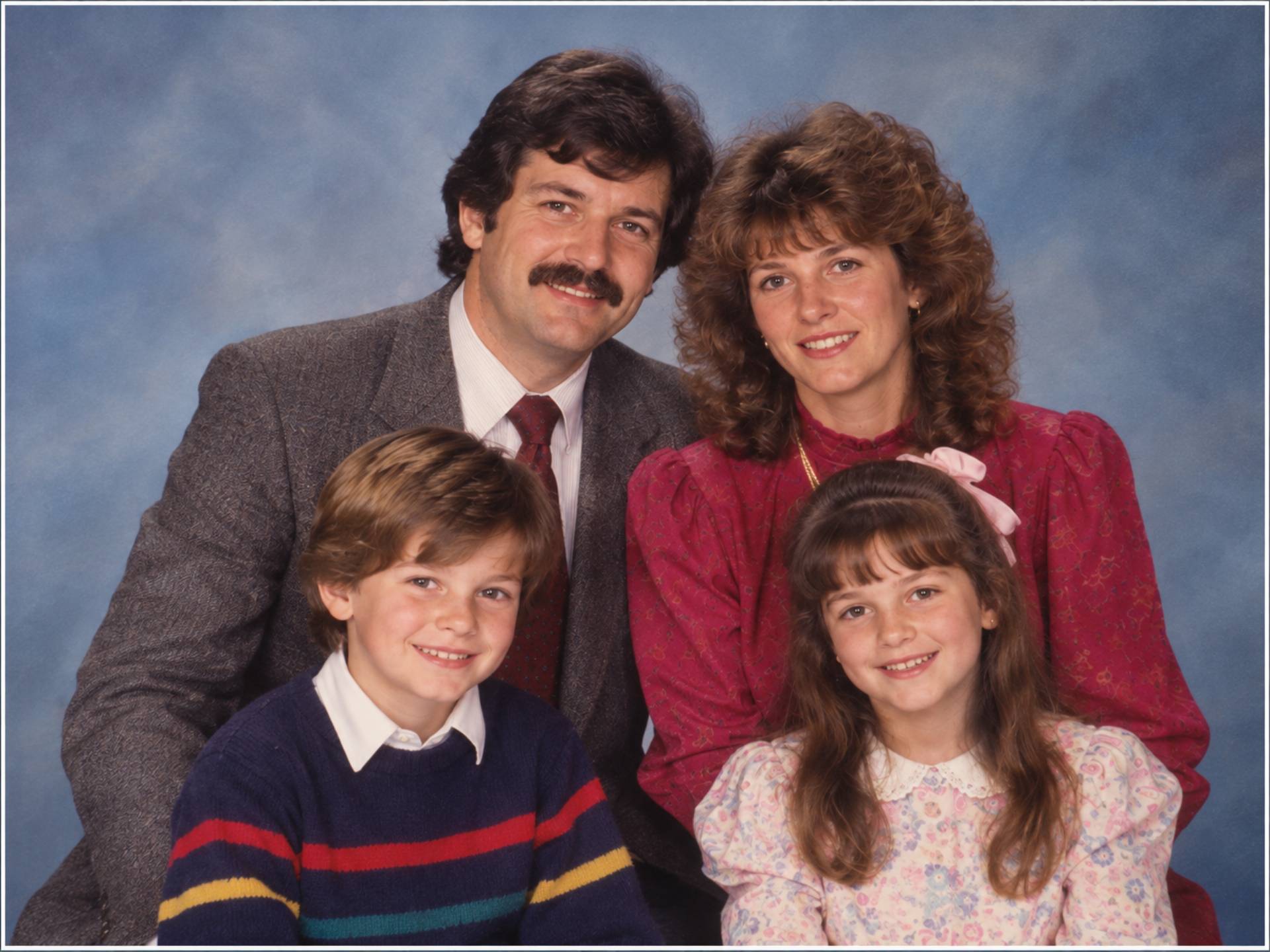
Recreate the uploaded family as a formal portrait made in a British high-street photography studio in 1983. Keep every person fully recognisable and preserve natural skin texture, age and family resemblance. Arrange the family in a simple seated-and-standing group against a soft blue-grey painted backdrop. Use restrained formal clothing, neat period hairstyles, balanced studio flash and natural expressions. Reproduce a clean early-1980s photographic print without modern retouching, cinematic colour or elaborate props.
3. Christmas at Home
A candid late-1980s Christmas morning family snapshot.
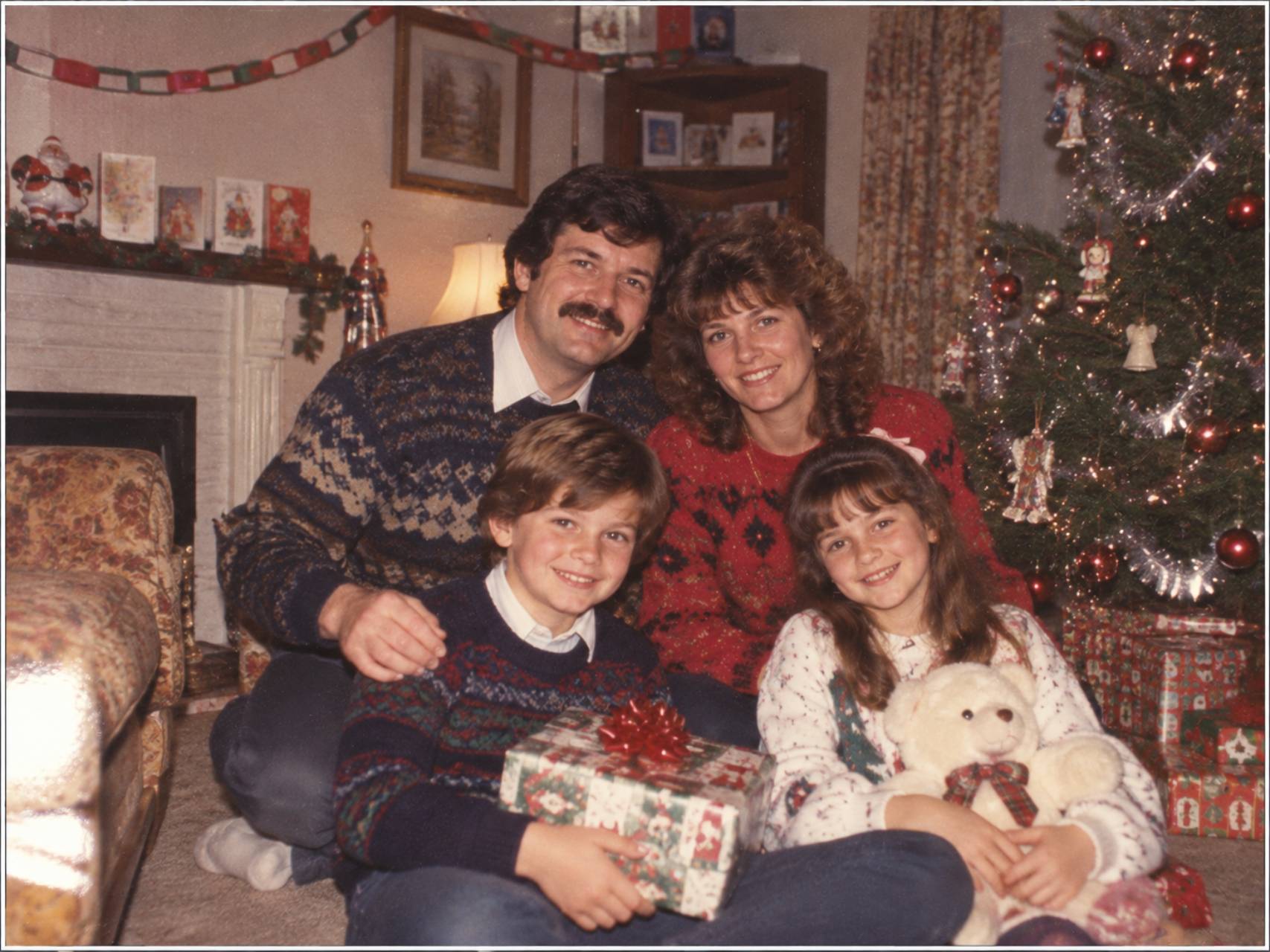
Turn the uploaded family photograph into a candid Christmas morning snapshot in a Leeds terraced house in 1987. Preserve all faces, ages and skin tones. Use ordinary indoor clothing and subtle late-1980s hairstyles. Add a modest artificial tree, paper decorations, a few wrapped presents and a television in a wooden cabinet. Show the family sitting naturally rather than posing like models. Use direct on-camera flash, mild red-eye realism, gentle film grain and slightly warm indoor colour. Exclude modern decorations, LED lights, smartphones and luxury interiors.
4. Back-Garden Birthday
A casual family birthday photograph in a Newcastle garden in 1984.
Create a realistic family photograph from a summer birthday in a Newcastle back garden in 1984. Preserve each person’s identity, age and natural proportions. Dress the family in simple summer clothes appropriate to the mid-1980s. Include a brick wall, basic garden chairs, a homemade birthday cake and a few balloons. Use natural overcast daylight, ordinary consumer-film colour and casual framing as if a relative took the photograph. Avoid perfect landscaping, modern garden furniture and fashion-editorial posing.
5. British Seaside Holiday
A candid British family holiday photograph taken in Scarborough in 1988.
Reimagine the uploaded family on a cool summer day in Scarborough in 1988. Preserve faces, ages, skin tones and family resemblance. Dress them in ordinary holiday clothes with light jumpers and windbreakers. Add a striped windbreak, buckets and spades, deckchairs and the distant outline of the seaside promenade. Use candid tourist-camera composition, changeable cloudy light and realistic late-1980s colour film. Remove modern buildings, phones, logos and excessively sunny tropical styling.
6. Scottish Family Gathering
A relaxed family gathering in a Glasgow tenement flat in 1982.
Transform the uploaded group into a relaxed family gathering in a Glasgow tenement flat in 1982. Preserve every person’s identity, age and skin tone. Use practical early-1980s clothing with some late-1970s influence, including knitted jumpers, a modest day dress and collared shirts. Include a patterned carpet, older upholstered chairs, a simple electric fire and framed family photographs. Use direct flash, natural expressions and slightly soft consumer-film detail. Do not add tartan stereotypes, modern technology or glamorous styling.
7. Welsh Sunday Family Portrait
A warm and ordinary Sunday family portrait in a Welsh Valleys home in 1986.
Create a believable Sunday family portrait in a modest Welsh Valleys home in 1986. Preserve the exact facial identity, age, complexion and proportions of everyone shown. Dress the family neatly in understated period clothing as if they have just returned from a family lunch. Include a floral three-piece suite, lace-covered side table, mantel clock and corded telephone. Use compact-camera flash, mild shadows and authentic 35mm print colour. Keep the scene warm and ordinary, without exaggerated nostalgia or modern objects.
8. Family with a new home computer
A late-1980s British family snapshot around a newly purchased home computer.
Recreate the uploaded family in 1989 gathered around a newly purchased home computer in a suburban British dining room. Preserve every person’s recognisable features, age and natural skin tone. Use restrained late-1980s casual clothing and realistic hairstyles. Include the computer, a small desk, paper manuals and an older dining-room cabinet, showing that not every object in the home is new. Use straightforward family-snapshot photography with direct flash and fine film grain. Exclude futuristic screens, internet imagery, wireless devices and excessive electronic equipment.
9. Wedding Anniversary Photograph
A warm British family portrait from a parents’ wedding-anniversary gathering in 1981.
Turn the uploaded photograph into a British family portrait taken at a parents’ wedding-anniversary gathering in 1981. Preserve each person’s face, age, body proportions and family resemblance. Use smart but affordable clothing appropriate to the occasion, with subtle early-1980s hair and make-up. Place the group in a hired function room with simple table decorations, patterned carpet and warm wall lights. Use a relative’s 35mm camera with direct flash, realistic shadows and slightly imperfect group arrangement. Avoid modern event décor and luxury hotel styling.
10. Black-and-white multigenerational portrait
A respectful black-and-white multigenerational British family portrait from 1980.
Create a respectful black-and-white multigenerational British family portrait in a local studio in 1980. Preserve every person’s identity, age, facial lines, skin texture and family resemblance. Arrange grandparents seated at the centre with adult children and grandchildren standing naturally around them. Use simple formal clothes, restrained hairstyles, a plain background and traditional studio lighting. Reproduce moderate film grain, balanced contrast and the appearance of a carefully printed black-and-white photograph. Do not beautify, de-age or modernise anyone.
Why Your AI Family Portrait Looks Fake
Every object announces the decade
Remove most of the props. A room needs only a few period clues.
The clothes resemble fancy dress
Replace neon colours and theatrical outfits with everyday garments appropriate to the family and occasion.
The room is too perfectly designed
Ask for furniture accumulated across different years, ordinary household clutter and one or two older possessions.
The family looks like unrelated models
Strengthen the identity-preservation instruction and ask the tool to retain family resemblance. Generate fewer people at one time if necessary. This is particularly important during Retro Family Portrait Creation, where changing too many faces at once can make relatives look unrelated.
The photograph looks cinematic
Replace “dramatic lighting”, “ultra-detailed” and “8K” with consumer film, direct flash, ordinary composition and natural skin texture.
Britain looks like central London
Name a specific regional setting and exclude famous landmarks unless they genuinely belong in the scene.
The image looks damaged rather than old
Reduce scratches, dust and colour distortion. Ask for a newly developed period print or gentle album ageing, not both.
Authenticity Checklist
Before using or publishing the portrait, check the following:
- Is the year clearly defined?
- Does the setting fit the named British region?
- Do all family members remain recognisable?
- Are their ages and skin tones consistent with the source?
- Do the clothes fit the occasion rather than merely the decade?
- Are the hairstyles believable without becoming caricatures?
- Does the room contain a reasonable number of period objects?
- Are some older possessions still present?
- Is the photographic style suitable for a consumer or studio camera?
- Are hands, jewellery, spectacles and teeth correctly formed?
- Is any visible text accurate, or should it be removed?
- Have smartphones, LED screens and other modern objects disappeared?
- Could the image be mistaken for a genuine historical photograph?
If the answer to the final question is yes, label it as AI-generated.
Privacy, Consent and Family Photographs
Family pictures deserve more care than an anonymous creative image. They may contain children, older relatives or people who would not expect their likeness to be uploaded to an AI service.
Obtain permission from the people shown wherever possible. Check the tool’s current privacy, storage and commercial-use terms before uploading. Avoid using sensitive photographs or images that reveal private information in the background.
An AI portrait should not be presented as a genuine photograph from the family archive. A simple label such as “AI-generated 1980s-style family portrait” preserves the fun without creating a false historical record.
Frequently Asked Questions
Can ChatGPT create a British 1980s family portrait from a photograph?
If image generation and editing are available, it can use an uploaded family photograph as a reference and change the clothing, setting and photographic style. Results depend on the source image and the number of people shown.
What is the best year for a British 1980s portrait?
There is no single best year. Choose one that fits the style you want. The middle of the decade offers familiar 1980s details, while early-decade images can retain more 1970s influence and late-decade pictures can include newer electronics and sportswear.
How do I stop AI from changing my family’s faces?
Use a clear source image and explicitly instruct the tool to preserve each person’s facial identity, age, skin tone, facial structure and family resemblance. Group images remain challenging, so inspect every face.
Which image ratio works best for a family portrait?
A 4:5 vertical ratio works well for a small standing group and for social platforms such as Instagram. Use 3:2 or 4:3 landscape for larger seated groups or scenes where the room is important.
Should everyone wear matching 1980s clothes?
Not usually. Coordinated but different everyday outfits tend to look more natural. Matching clothing is suitable only when it reflects a deliberate family choice.
How much film grain should I add?
Use fine or moderate grain. Heavy grain and scratches can overwhelm faces and make the effect look artificial.
Can I use a real old family photograph as a reference?
Yes, provided you have the right to use it and the people shown have consented where appropriate. Ask the AI to restore or reinterpret it carefully without changing identities or inventing historical details.
Should I disclose that the portrait was created with AI?
Yes, particularly when the finished image could be mistaken for a real family photograph from the 1980s.
Create a Family Memory That Feels Believable
The best British 1980s AI family portrait is not necessarily the brightest or most obviously retro. It is the one that feels specific enough to belong to a real family.
Choose an exact year. Give the family a reason to be together. Dress them for that occasion, place them in a believable British setting and add only a few objects that support the story. These details work together to create an Authentic 1980s Family Look without relying on exaggerated retro clichés. Most importantly, preserve the faces and relationships that make the source photograph personal.
The 1980s were not made entirely of neon, celebrity fashion and famous gadgets. They were also floral sofas, practical jumpers, cloudy holidays, direct camera flash and imperfect photographs kept because they mattered.
When an AI portrait captures those ordinary details, it begins to feel less like a retro costume and more like a memory that might genuinely have been found in a British family album.
Suggested Images
- Feature image: A British family posed in a realistic 1985 sitting room with a floral sofa, wooden television cabinet and direct camera flash.
- Comparison image: An exaggerated neon AI family portrait beside a restrained, authentic British version.
- Studio portrait: A multigenerational family against a simple early-1980s photography-studio backdrop.
- Christmas scene: A candid family picture with paper decorations, a modest tree and realistic compact-camera flash.
- Seaside portrait: A family behind a striped windbreak on a cool, cloudy British beach.
Recommended feature-image alt text: Realistic British 1980s family portrait created with AI in a period sitting room